HCC 2025 Report
Hawkesbury Canoe Classic 8-9 November 2025
The Hawkesbury Classic Paddle is a unique opportunity to pit yourself against the physical and mental hurdles thrown up by a 111km, overnight, paddle from Windsor to Mooney Mooney on Sydney's majestic Hawkesbury River. Lane Cove River Kayakers is a longstanding supporter of the HCC with substantial experience amongst our paddlers. The report below provides a perspective on the experience that was HCC 2025
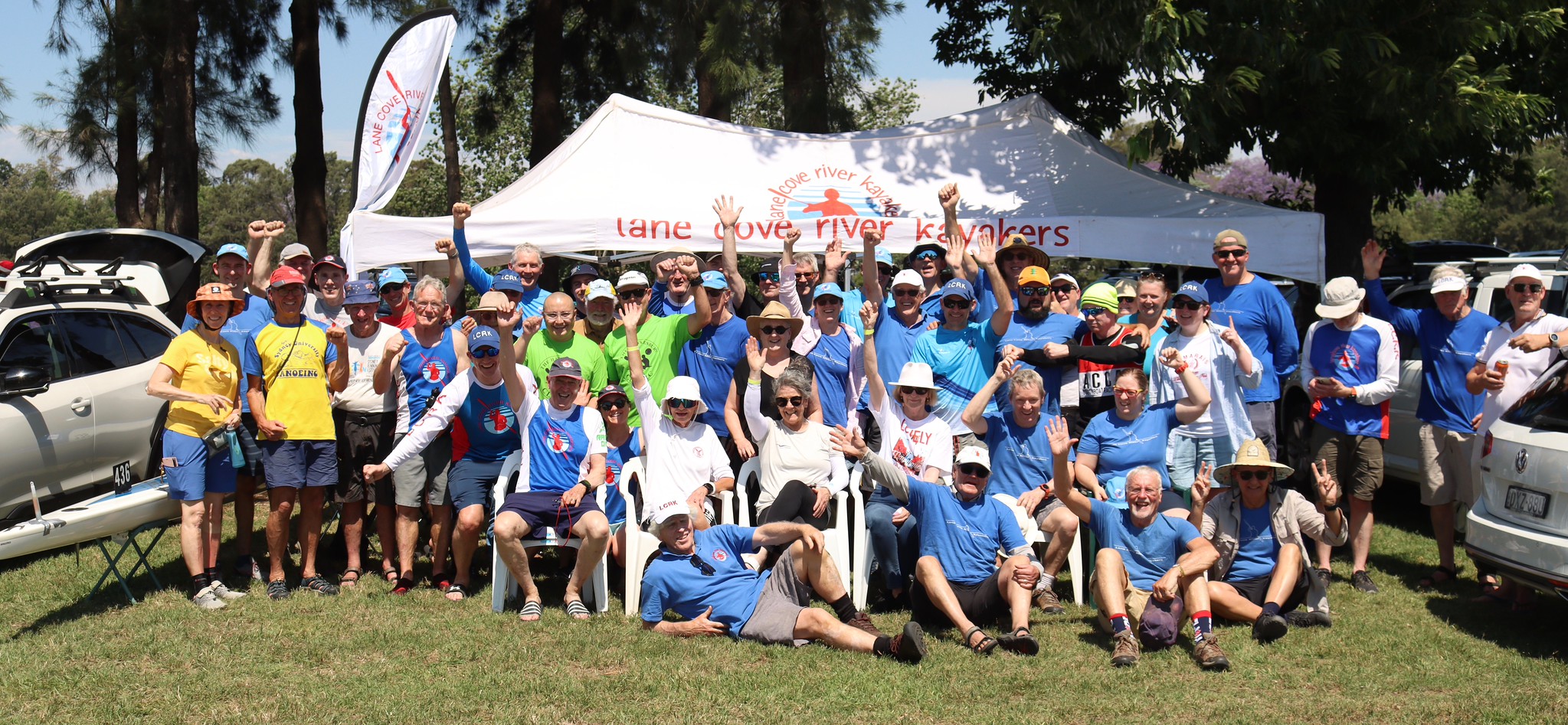
Above: Most of the LCRK contingent at Windsor
2025 LCRK Results
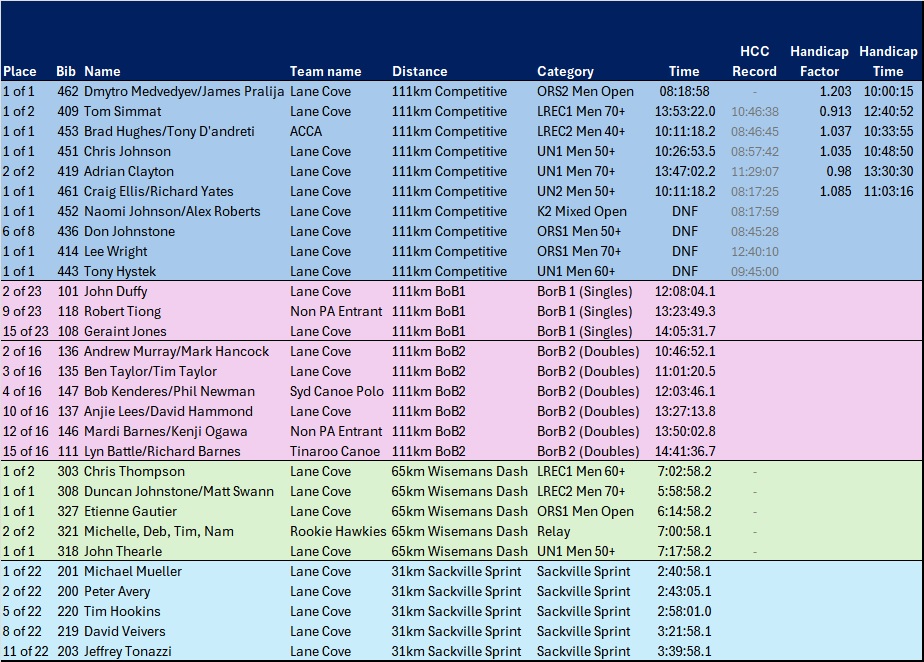
The table below shows the results for LCRK Paddlers - sorted by 111km vs Dash vs Sprint distance
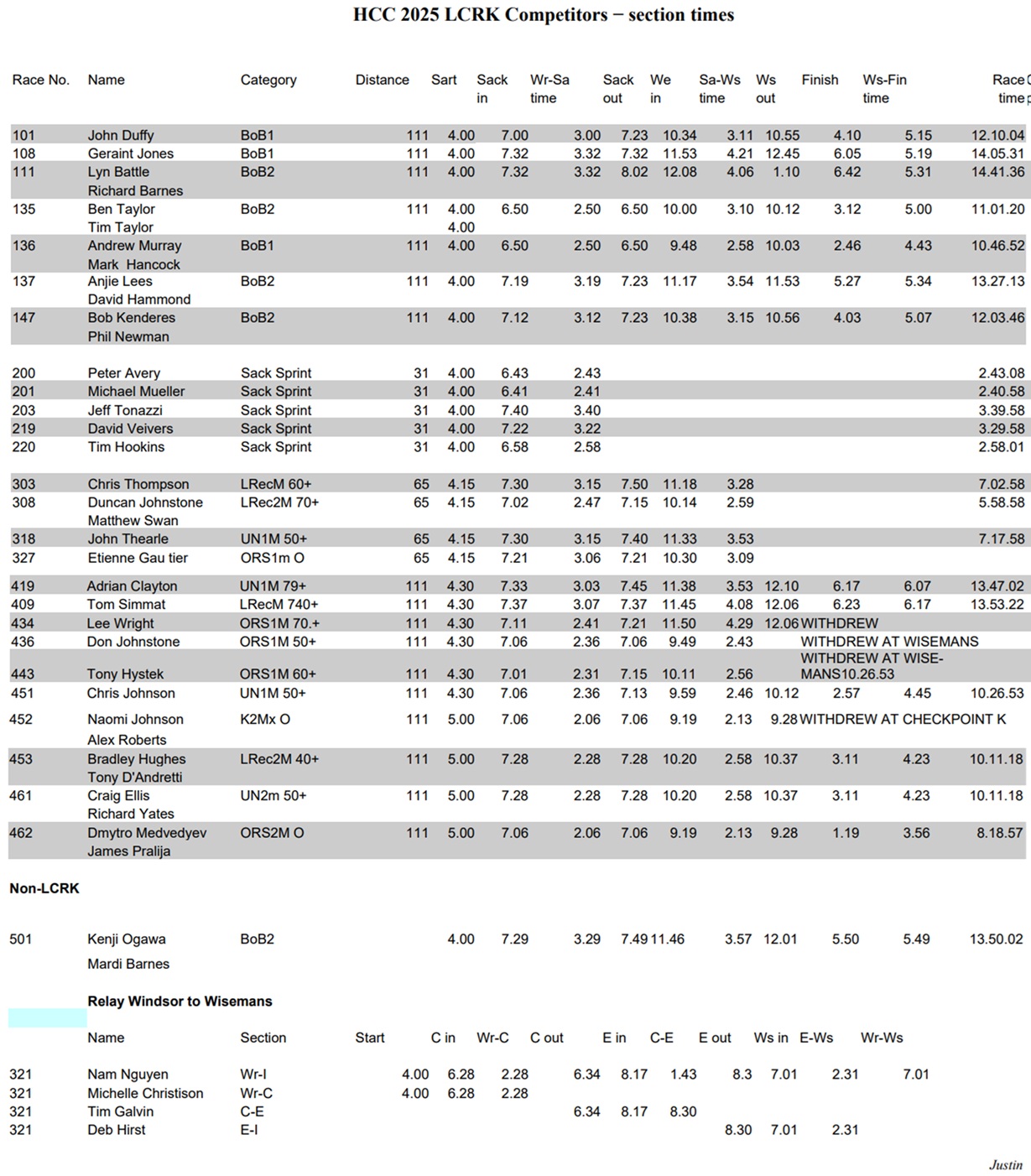
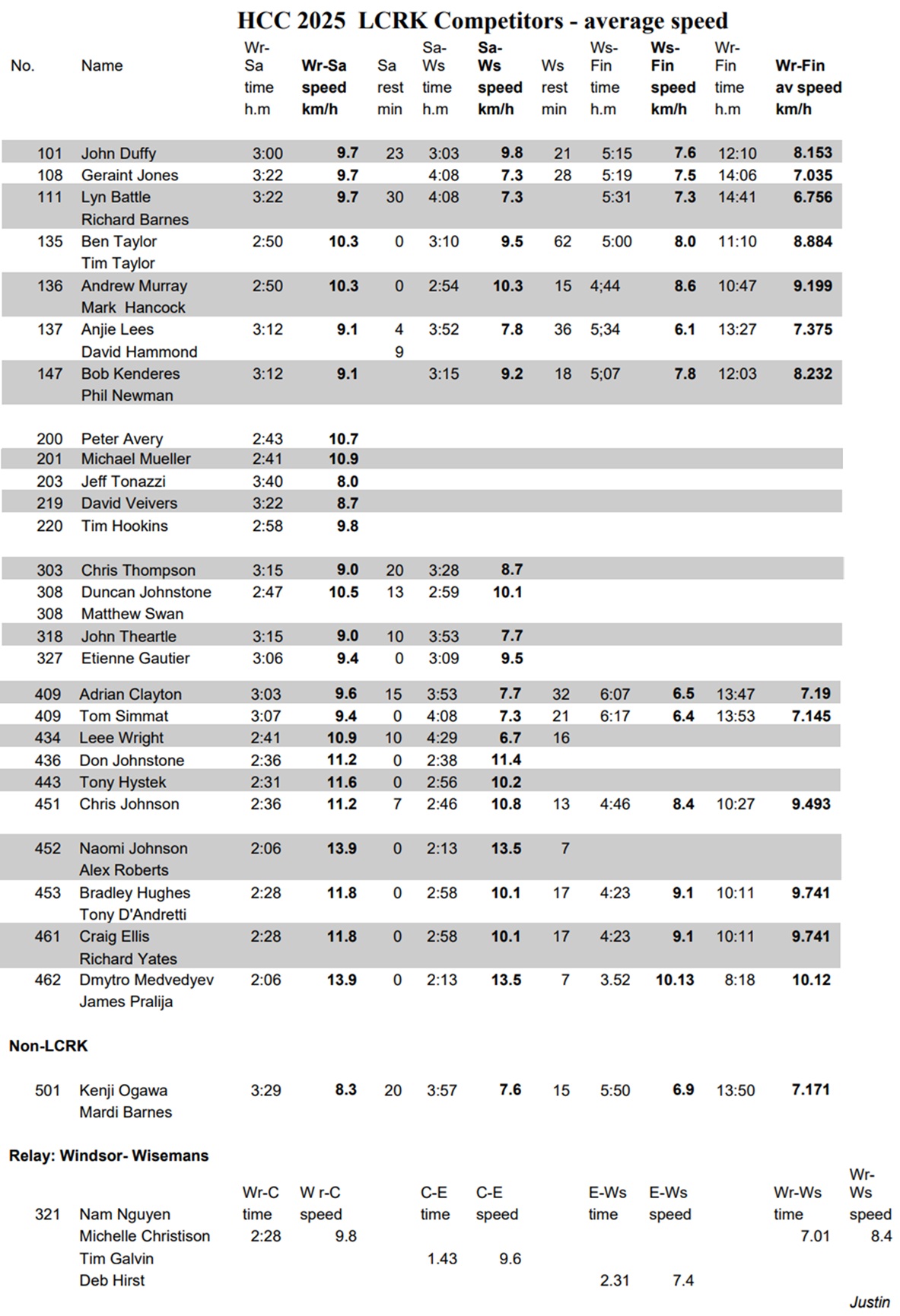
2025 LCRK Splits - Average Speed/Pace/Times - Justin P
Justin Paine - ably assisted by Tim McNamara had a mission for the night - to record the times of passing LCRKers at Sackville and Wisemans in order. This provides key information on splits and average speeds (and stop times) that give insight into paddling strategies for individual boats.
Justin reported that conditions at Sackville were difficult for timekeeping, with competitors landing at two beaches 200 metres apart, and some passing non-stop and so far out in the river it was hard to hear boat numbers when they were called out. Estimated times have been used in the chart where numbers were missed - these can be updated if there are material anomalies.
Above: LCRK Average Times by zone
- CLICK for above table as a PDF
Above: LCRK Average Speeds by zone
- CLICK for above table as a PDF
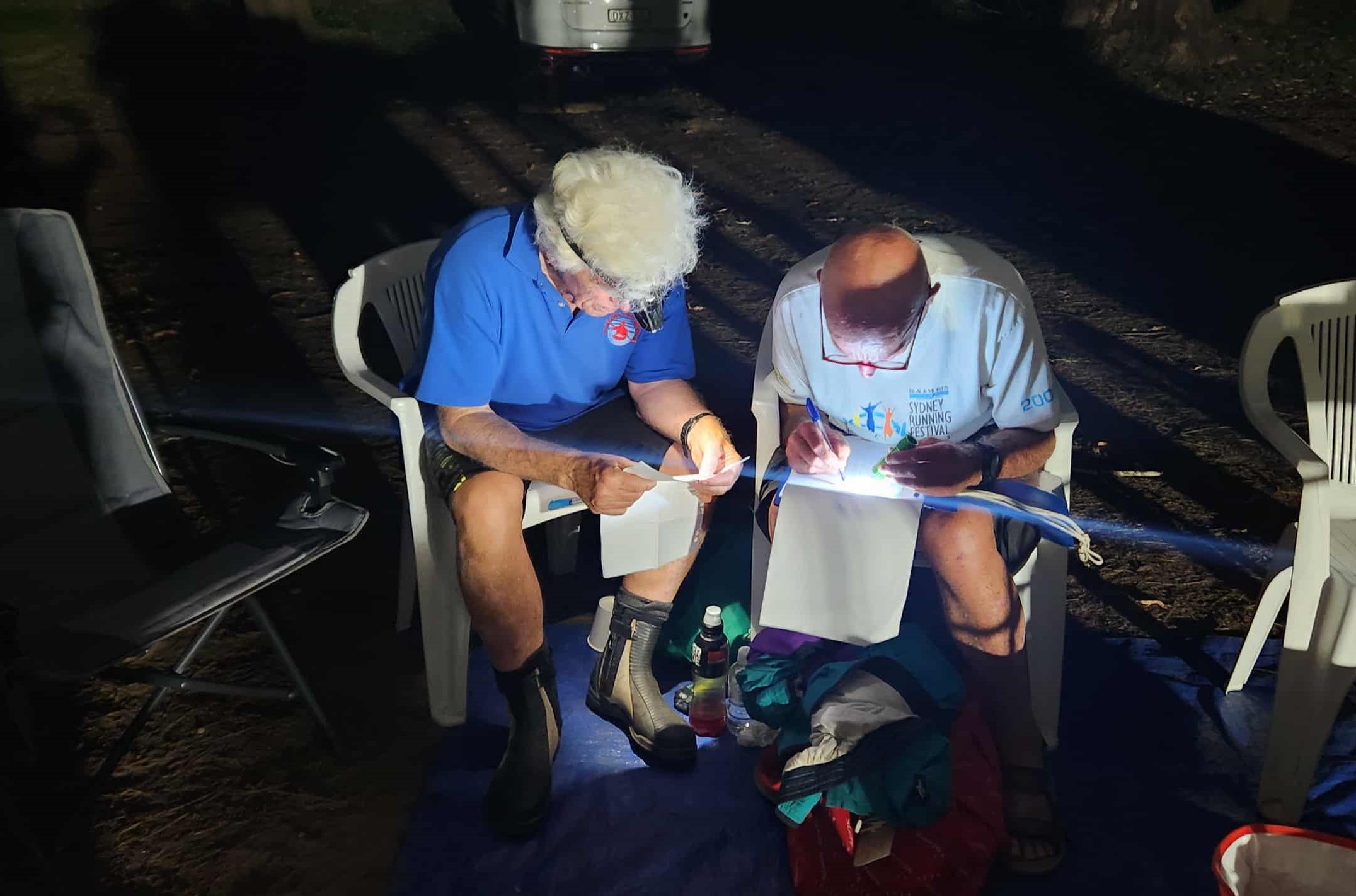
Above: Justin & Tim - buried in the stats! Photo - Elke van E
Reflections from the River: The Hawkesbury Canoe Classic - Phil Newman - 12:03:46
Each year, the Hawkesbury Canoe Classic draws a remarkable mix of paddlers—young and old, seasoned and new—each arriving with their own dreams. Some chase speed, some a personal best, and others simply the finish line. But all come to test something deeper: their resolve, their courage, their mettle.
You see it in the quiet moments before the start. The nervous smiles. The whispered doubts. The obsessive gear prep'. Each paddler carries their own story, their own fears, their own hope of becoming the best version of themselves—if only for one long, this year, moonlit night.
Some go solo, embracing the solitude and the challenge of self-reliance. Others paddle in pairs or teams, placing trust in shared rhythm and mutual strength. That trust is beautiful—and risky. One injury, one mishap, and the dream can falter. But together, they chase something faster, something greater.
And yet, beyond the individual journeys, something extraordinary emerges: a collective spirit. A river of determination. A community of grit and grace. Each stroke, each cheer, each checkpoint manned by amazing volunteers—woven into a tapestry of shared purpose.
To the organisers, the volunteers, the support crews, and the friends and families waiting at the finish: thank you. You don’t just support the paddlers—you elevate them. You turn a race into a movement. A challenge into a celebration. A river into a story worth telling.
Here’s to every paddler who dared. And to every soul who helped them dare.

Above: Phil & Bob at Pitt Town (photo: Ian W)
HCC #1 - Geraint Jones - 14:05:31
The idea was planted in my head about 2 years ago when I noticed some Hawkesbury Classic trophies on a friend’s sideboard. He described how great it was and how he only did a bit of training beforehand (I’ll be having words with him about this). I then bought myself a sea kayak and started coming along to the LCRK Wednesday night paddles. Since most of my energy was expended carrying this tank of a kayak to the water, I swapped this for a lightweight and optimistically tippy kayak (everyone did warn me to get something stable to start with). I then spent a year wobbling and gaining valuable swimming practice. Earlier this year I ‘luckily’ cracked this kayak during the LCRK’s self-rescue training day. So, I threw in the towel and got myself a surf ski (easier to climb back onto!).
After completing the Myall Classic this year, John Duffy told me that if I can complete the Myall then the HCC is easier by comparison due to the pit stops (I’ll be having words with him about this). Hence, I signed up for my first HCC…
So, after peppering John Duffy and Duncan Johnstone with hundreds of questions: “how do I know which way to go in the dark? etc...” and finding myself a Landcrew (Thanks a million Scott & Eli Tyers!) I felt I was ready. So, with a military style checklist, scientifically measured amounts of carbohydrates etc I headed for Windsor. Unfortunately, my seat pad blew off somewhere between home and Windsor. Panic diverted, as I realised, I had a spare stability pad in my car. However, after I started paddling, I realised the stability pad had a less slippery surface* than my usual top pad and was incredibly uncomfortable for my posterior.
* I’m not sure if this slipperiness comment is factually correct, but psychologically it was definitely the problem.
At Sackville, Allana Ewin magically appeared with a sheet of Teflon (I didn’t even realise such a thing existed), and this made a huge difference to my comfort levels. I know I would never have made it to the finish without this addition to my seat.
As night fell, my race became more interesting….
An hour after leaving Sackville, I encountered a group of teenagers who were swimming in the darkness and having a great time surprising the passing kayakers. They definitely surprised me. Since, I had paddled a bit too close to a mubank, they offered to ‘help’ me get back out into deeper water. So, as one gave me a semi-helpful push, his mate decided it would be more fun to simply tip me over @#$%! In defence of the teenagers, they were equally annoyed by the antics of their one mate. I politely declined their further offers of help. I remember feeling particularly low as I was exiting the Big W, especially as I was getting my mental arithmetic wrong and thinking I still had another hour and half before I reached Wisemans Ferry. To my relief, Wisemans appeared within half an hour, and I was greeted by a fantastic firework display that was majestically reflected off the river (I’m pretty sure this happened, and I wasn’t hallucinating!).
At Wisemans, I got into some dry clothes and after a longer than planned stop, and some gentle coaxing by Scott, I continued on…
An hour after leaving Wisemans I was nearly garrotted by a fishing line from an unattended fishing rod at the end of someone's private jetty. This siren of a jetty was cunningly disguised with fairy lights to resemble a check point. That was swim number 2.
Everybody had told me not to stop at the Low Tide Pit Stop as “you will never want to leave”. However, I couldn’t resist! I was very grateful of the warm fire, the friendly chat, the cup of coffee and the encouragement that: “I was almost there”.
As I headed back out onto the river, I witnessed some spectacular shooting stars and then watched the sky get gradually lighter as dawn approached. While exhausted at this point, I at least felt that I was counting down the kms. However, as I rounded Bar Point and again within sight of the finish line, I went for two more swims. I’d like to say the waves were three feet high (they weren’t), but I think any size ripple had the potential to tip me over at this point. I was very glad I attended the self-rescue course earlier this year!! The most important lesson I remembered, was to take a breather after getting my body over the kayak before attempting to get my legs on. After umpteen attempts to remount without simply flipping over the opposite side, I was tempted to just drift with the tide, hanging onto the side of my kayak for the final 500m. I decided this would be a bit undignified, so with one final herculean effort (in my opinion) I managed to get back on board. Cue the sun rose over the horizon!
It was a wonderful feeling to reach the finish and be handed my medal. It's strange how I spent 14hrs thinking "I'm never doing this again" to now thinking "next year I must get a better glue for my seat…".
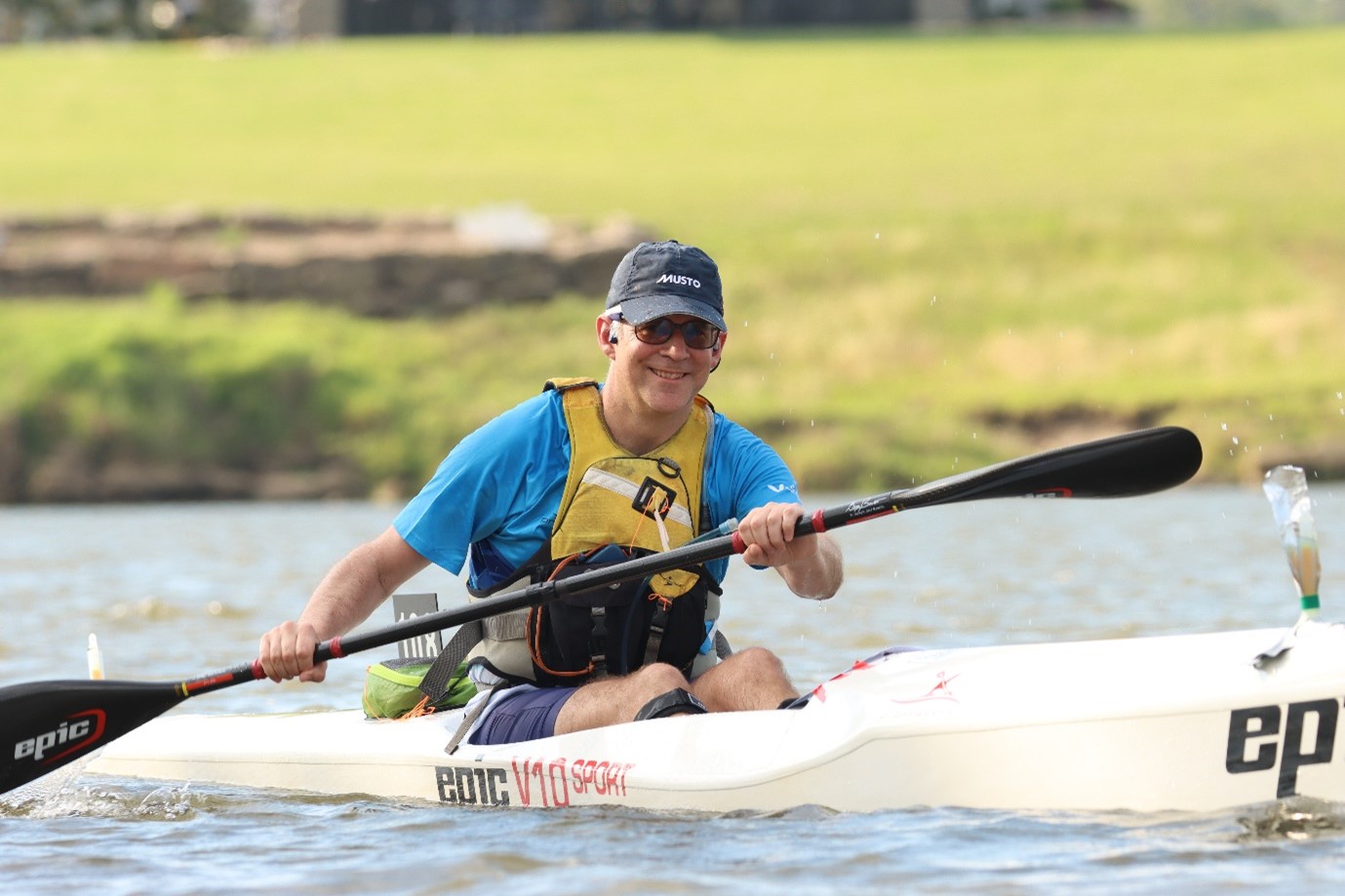
Above: Geraint at Pitt Town (photo: Ian W)
HCC Race Report - Dimi M - 8:18:58
I hadn’t seriously considered paddling the Hawkesbury Classic until last year. The idea of paddling for nine hours straight just seemed too hard — something beyond what I could do.
But after completing several ultra-marathon races over the past few years, the Hawkesbury Classic eventually found its way onto my radar. I still thought it would be incredibly tough in a K1, but when my good friend and accomplished marathon paddler James Pralija asked if I’d be interested in racing it in a double, it suddenly seemed much more achievable. So, our preparation began.
We logged plenty of long training sessions, often with our teammates Alex and Naomi, who were set to paddle the race in a K2. James decided we’d use a double ski — a bit longer and slower to accelerate, but noticeably more stable, which we’d later be thankful for.
We were also fortunate to have Peter Manley on our side. A regular participant in this event, Peter had to skip this year’s race due to a shoulder injury and generously volunteered to be our land crew instead. We arrived at the race venue early in the afternoon, got our boats scrutinized, and completed our final preparations — checking hydration bladders, gels, solid food packs, and spare warm clothes for the checkpoints.
The Start
Our race plan was to paddle strongly through the first half and cover as much distance as possible while it was still light and the tide was helping us. We started at 5 PM (in the latest group) and immediately faced a fairly strong headwind for the first half hour — not ideal for our plan. Luckily, the wind soon dropped, and we began to take full advantage of the outgoing tide, swapping leads with Alex and Naomi and maintaining an average pace of around 14 km/h.
Watching my heart rate, I realized we might be pushing a bit too hard, so I tried to conserve energy whenever I could while recovering during their turns in the lead. With James having done this race several times before, and Naomi being an experienced Hawkesbury paddler (she must’ve finished it a dozen times!), I trusted that our experienced partners knew what pace we could sustain.
Through the Night
We skipped the first big checkpoint at 30 km and continued toward Wisemans Ferry, our first planned stop. The section was fairly uneventful, apart from a brief scare when we hit our rudder while overtaking a slower boat on the inside line. By the 50 km mark, we had caught nearly all the paddlers who had started 30 to 60 minutes ahead of us, except for a couple of doubles, who reached Wisemans just minutes before we did.
We covered the first 60 km in 4 hours 20 minutes, much faster than I had expected. But we knew the second half would inevitably slow down — the tide would turn against us, and we’d lose the light.
At Wisemans, Peter and Andrew Pratley (who was looking after Alex and Naomi) were ready and waiting. They helped us out of the boats, refilled our hydration packs, and handed over gels, food, and warm clothes. After a quick stop — plus a few extra minutes waiting for the ferry to cross — we set off again. For the next few kilometers, both doubles paddled together, but soon Alex and Naomi started to slow. Even at a steady pace, they were struggling to keep up. We decided to stop at the next checkpoint to check on them. Unfortunately, Alex had pushed himself beyond his limits and hit the wall. They faced a tough decision: this checkpoint was the last with road access. Continuing would mean another 30 km in the dark, against the tide, without a safety net. In hindsight, they absolutely made the right call to withdraw there.
The Long Push to the Finish
It was a setback to lose our teammates, but after a brief regroup, we decided to continue — with a key adjustment. We swapped seats so that I would take over navigation and set the tempo. It took a while to get used to steering and reading the GPS in total darkness. At one point, we even ran straight into some tree branches. Thankfully, as the moon rose, visibility improved and the river became less mysterious.
With about 15 km to go, another challenge struck — James’s shoulder started giving him serious pain. Soon, he was in agony, but with no nearby roads or beaches, stopping wasn’t an option. Fortunately, the next checkpoint had painkillers, which gave him enough relief to continue. We found that lowering our arms and adjusting our paddling rhythm made the pain more bearable.
The final kilometers were brutal — choppy open water, exhaustion, and darkness all combining to test us one last time. Physically and mentally, we were spent, but this was when I truly appreciated James’s choice of craft. In a less stable K2, that final stretch could have been a nightmare.
Then, finally, we rounded the passage between the land and the island — and there it was: the Mooney Mooney Bridge, with its flashing orange light marking the finish.
It was a wonderful night — the river reflecting the full moon, lightning flashing on the horizon, stars everywhere, even a few shooting stars. But nothing compared to that orange light — the most beautiful thing I’d seen all night.
'The Finish
A few final strokes later, we crossed the finish line — the first boat to do so. As I later learned, we had even set a new Open Men’s Double record, though at that moment, none of that really mattered. Andrew was waiting to help us out of the boat and hand us some warm clothes. Moments later, Peter arrived with Alex and Naomi, offering much-needed post-race drinks. Together, we packed up and made our way home — tired, sore, but deeply satisfied.
Before the race, I’d asked several paddlers who had done both the Myall and Hawkesbury races which one they found tougher. Some said Myall was more demanding because of its higher intensity. I reserved my judgment until after finishing the Classic — and now, having done it, I believe the HCC is the harder race, at least the way we tackled it. Being more than twice as long and raced partly in the dark, there are simply more opportunities for things to go wrong, even for experienced paddlers.
A massive effort all around — and huge thanks to my teammates, our land crew, and the event organizers for making it such an unforgettable experience.
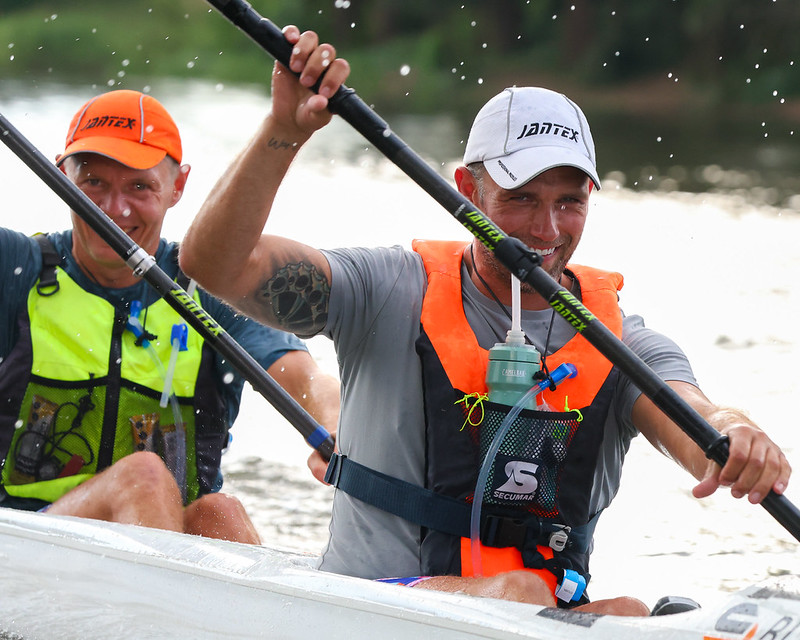
Above: Dimi & James at Windsor (photo: Tom H)
Teamwork, Drive and Heart - Naomi J Hawkesbury Race Report 2025
Teamwork
Alex agreed to paddle the Hawkesbury with me based on just the one timetrial in the club’s Knysna back in February, and it wasn’t until after his Worlds campaign that we really started training in the K2. After a blisteringly fast Myall, we did 20-30kms most Saturdays and Sundays, often with the company of the other LCRK Div 1 guys. Mixed-gender doubles can sometimes feel like a can of worms, trying to reach the happy medium of two very different bodies and levels of power. Yet the boat and crew clicked beautifully, singing along above 12kph with so very little effort.
The training block pushed me to level up my paddling, really thinking about how to work smart on wash and pull my heart rate down rather than just thrashing away. I learned to trust that Alex’s power would get us back on a wash, and that he could read from the slightest increase in my cadence when I wanted more or less from the back seat. I am amazed that he managed to fit so many kms in around work and a young family, always turning up chipper and raring to go, if occasionally only two minutes before our agreed start time.
Yet we should have stress tested things sooner, doing a paddle longer than four hours, ideally at night or in the heat of the afternoon. At 12kph, 30kms is done and dusted in just two and a half hours.
Drive
With so much training under our belt, and the team now augmented to include James and Dimi in a double ski, it seemed only natural that we would set an ambitious, one might even say audacious plan for the race. The 8:17:59 Mixed Open K2 record was set in the 1985 flood year by a cracker of a crew, and yet the numbers were working out. Just over 12kph average for the whole thing including stops, which meant we needed to get into Wiseman’s with an average a tad over 13kph to compensate for an incoming tide in the back half.
Through the adverse wind of the first 20min, and we started flying. Alex is a wonderfully enthusiastic paddling partner, and called out average splits from the back seat like a champion. 4:30/km, pull back onto the wash and get our heart rate down. 4:20/km from Dimi and James, then 4:10/km, and down to 4min as we neared Sackville and cleared the ferry. The boats we passed whooped and cheered.
Twilight seemed to last forever as the boats thinned. Somehow there was still a bit of light as we passed through Lower Portland Ferry and the darkness finally brought a little relief from the heat. My navigational GPS decided not to turn on and yet I didn’t need it my memory of the river by night was so strong; each turn felt familiar as we ate away at the kms. Still sharing leads more-or-less 1km for 1km, the two boats flew into Wiseman’s Ferry in 4hrs 20, 10min ahead of the planned race schedule.
Yet in all the thrill and adrenaline of speed I forgot the golden rule of leaving Wiseman’s feeling fresh. As the experienced Hawkesbury paddler, I should have checked on Alex rather than rushing to leave.
Heart
Nobody wants to finish their night hanging out at Checkpoint K feeling thankful that an emergency blanket was part of our compulsory equipment list. While the volunteers there were lovely and very welcoming, we had always intended to push hard all the way to the finish.
I so value James and Dimi for their sense out in the dark; their realisation that Alex had properly cooked himself, their firm reminder to me than it takes two with-it paddlers to get a racing K2 across Bar Point in the dark. Working as a team of four we had pushed harder than I think any of us would have dared to alone, and yet it is in the moments when things fell apart that I learned the true value of such a team. I’m glad the boys continued on to the finish; their final time doesn’t quite do justice to how commanding a race they put together, and certainly not to their selflessness in standing on a dark beach making sure we were ok. And I so value Pete for driving an hour each way to pick us up from perhaps the most inconvenient location that we could possible have picked by road. Warm, dry clothes were a relief, as was arriving at Mooney Mooney to hear James and Dimi’s tale of their final 30kms.
I learn a lot about myself each time I paddle the Hawkesbury, this year perhaps more so than the rest. The dance of drive and teamwork for us to crack that record will have to wait for another year, next time tempered with a little more wisdom.
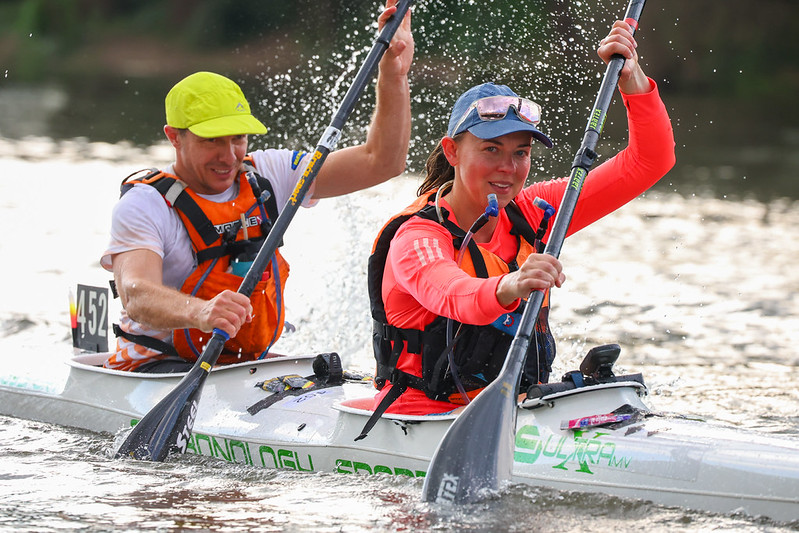
Above: Naomi & Alex at Windsor (photo: Tom H)
Hawkesbury Canoe Classic – A view from the sidelines - Peter Manley
I was privileged to be the support staff for 2 gun boats – James P & Dmytro and backup for Naomi & Alex. Just like when you choose your doubles partner, it’s best to select fast ones so you can get home to bed before anyone else.
It started with JP advising he was “running a little behind” and would be to my place to collect me “soon”. It did leave us running a bit tight for time, and a few panicked phone calls to anyone who would answer to confirm scrutineering would remain open for us were required. Once confirmed we could relax on the way to Windsor (though Naomi may not have been, having gone earlier). Once cleared by the officials we could all try and stay cool and catch up with the other competitors.
The last start (5:00pm doubles) saw Keg make his dash to be 1st to the bridge while my teams recognised there was a long way to go so took it relatively easy.
The trackers are great and all the landcrews could watch with interest the status of all boats though those of us with Telstra as a mobile provider had a better chance of connecting. A few landcrews went for a dip at Sackville to cool off while we waited and soon enough boats started arriving. My teams cruised by looking strong and hauling in other boats.
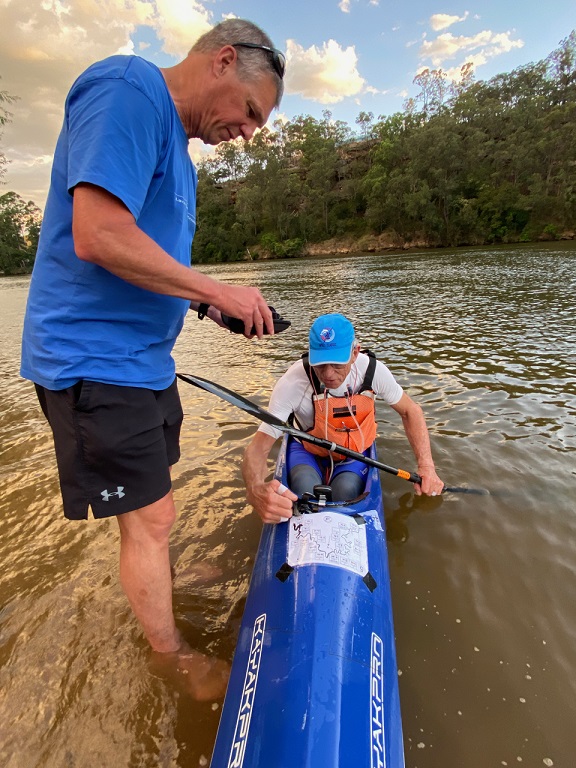
Then off to Wiseman’s where Steve, Selina, Elke and others had done a great job setting up the LCRK site, including quite a range of snacks. I was able to spend some time with them as those on the water were still a fair way off. That said when they did arrive it was like an F1 pitstop – change of top, drink and a sandwich, fresh bladder connected into the boat and away – all within the designated 5-minute window. At this stage Alex wasn’t feeling 100% but persevered.
I then headed earlier than other to the finish expecting some quiet time to myself where I could catch up on some reading (and finishing the LCRK monthly accounts). Alas it was not to be. A call came in from Andrew P (who was cycling the course) that Naomi and Alex were at Checkpoint K having withdrawn due to ill health. Now I was torn – I needed to collect Naomi & Alex, but my other crew would arrive while I was away. Thankfully, Richard Andrews had arrived to assume his shift at the finish, so I left bags with him and headed off.
A dark and lonely drive via Spencer and then almost missing the checkpoint land entrance but was let in and met a relieved crew. The 1st aiders had looked after them well, but a change of clothes was welcome. Then back to the finish.
Boats loaded on to the roof then a celebratory whiskey before heading for home, by 3:30am (any other landcrew jealous?).
Well done to all the paddlers.
Adrian's HCC 2025 - 13:47:02
HCC2025 was to be the sixth time I’d entered the race. You would think that I might have learnt something about the event. Apparently not.
Given that I had a significant birthday earlier in the year it didn’t require a lot of ego stroking to get me signing up for the HCC2025 after the opening date for entries. To be only the second 80+ year old (behind our own Justin Paine) to complete the event solo was definitely the main driver behind my decision to enter for the full distance.
There was a lot getting in the way of my preparation for this year’s Classic with the consequence that I was well and truly underdone in terms of having the level of paddling fitness needed for a half-decent result. I used the Club’s spreadsheet to determine my finishing time (the spreadsheet had been surprisingly accurate with the two previous occasions that I had used it) based on an average flatwater paddling speed of 8.5kph – down .2kph on the speed I had averaged in the 2023 event. This had me finishing a tad under 12 hours. Tom Simmat’s yardstick that my time would be 10 times that of the 12km time trial I paddled immediately preceding the Classic came up with a similar result.
My time of 11:29 for HCC2023 was a record for 70+ in the UN1 division. I was 78 when I set it. This year Greg Thompson of the Penrith Club, a mere whippersnapper of 70 and a seasoned HCC participant, was the competition and most likely to be the new record holder at the end of the race.
Race day started badly. The trip to Windsor was beset with issues determined to raise my anxiety level – the traffic lights, along with road closures due to the Warringah Freeway upgrade, definitely conspiring against me. The situation was not helped by the realisation that half an hour into the trip I had left the typewritten instructions for my land crew at home and needed to backtrack to get them.
I arrived at Windsor with Lindsay Somerville, a workmate going back 50 years and backing up for the fourth time as my landcrew, a little after 1:00pm. From this point up to the start things went relatively smoothly; the only glitch being the need to scrounge a space blanket from Tony Hystek in order to satisfy the scrutineers. It didn’t take long after the start to realise that an 8.5kph average speed wasn’t going to be achieved. It looked okay at Checkpoint A but I was well off the pace arriving at the phantom Checkpoint B. I got to Sackville close to 15 minutes behind schedule. I was in the company of Tom S and John Thearle for some of this leg and enjoyed a gentle wash ride behind Kermit, with Richard and Lyn Battle aboard, for the last couple of kilometres into Sackville.
The Sackville stopover went smoothly. Jana Osvald gave me a massage to relieve a bit of tightness around my neck and shoulders and a lathering of Gurney Goo on my lower back to soothe some chafing.
The start of the Sackville-Wisemans leg went according to plan -- I wasn’t losing any more time. Nightfall had arrived by the time I got to Checkpoint E. I tacked onto a Mirage Double a little way upriver from Portland and was helping its crew negotiate the twists and turns of the river into the start of the Big W. It was nice to have Kenji and Mardi Barnes in their Mirage double as company for a short time. I was also having regular encounters with the merrymakers in the 14-person canoe.
Not long into the Big W things started to go a pear shape. I capsized twice (at 50 and 54km) before getting to Checkpoint H at the end of the Big W; both times as a result of running into protruding branches on the left-hand side of the river. The first capsize had me sensing dejas vu – something similar happened upriver from Checkpoint K in my 2014 HCC which ended up with me losing my paddle and registering a DNF. The second capsize resulted in a deep gash to the side of my head.
Now further behind schedule (recovering from the capsizes added around another 12 minutes to my time), wet and cold and with spirits also dampened, I limped into the Wisemans’ checkpoint for a much-needed break. The cut to my head must have looked pretty bad so an ambo officer was summonsed to patch me up. While this was happening the Mudlarks were sorting out the water in my boat caused by the capsizes
The support I received from the Club’s crew at Wisemans helped buoy my spirits enormously. A change of clothes, a couple of Elke’s cookies washed down with a couple cups of hot tea, a neck and shoulder massage plus more Gurney Goo from Nam, had me ready to take on the final 40km to Moonee Moonee. As I paddled off, a little behind Tom S, Kenji and Mardie, exuberant encouragement from the Mudlarks further lifted my mood. With the time lost with all that had gone on before I wasn’t interested in chasing a time so paddled at what I considered to be at a pace I could sustain. Even so, I was passing other boats and cannot recall being overtaken by another boat on the leg from Wisemans to Low Tide Pit Stop.
I’d not succumbed to the lure of the Sirens at Low Tide Pit Stop on my previous tilts at the HCC. However, this likely being my last opportunity, I felt I should experience the legendary delights that the site offered. Helped out of my boat and seated beside an open fire, I enjoyed a couple of cups of hot chocolate in the company of Ange and Dave – the first time I’d encountered them on the night.
The 14 merrymakers in their canoe converged on Low Tide Pit Stop, along with Kenji and Mardi, just before I departed which was a few minutes after Anje and Dave had left in their double.
After a few kilometres I caught up with Ange and Dave who had an OC1 in tow. I stayed with them for a while before gradually drawing away. The tide was now very much in our favour and around this point I clocked up my fastest kilometre for the night -- slightly over 11kph.
Down river from Checkpoint O, and roughly one TT away from the finish I was starting to experience moments of imbalance and needing to throw in an occasional support stroke.
Locating Checkpoint P was a challenge. There were quite a few boats gathered where I thought P would be. I chose the wrong one and had to a bit of backtracking to find the right craft. I wondered if other paddlers had experienced the same confusion.
As it widened the river was showing more obvious signs of being affected by wind against tide. I was needing to really concentrate on keeping the boat on even keel and throwing in support strokes more frequently in order to do so.
Once I reached the starboard light on Bar Point I made a bee line for the port marker off Prickly Point at the head of Milson Passage. This represented an open water crossing of close to one kilometre which I new would be a challenge but felt confident that I could complete it safely.
The wind in this exposed environment was creating more chop and I was finding my concentration trying to keep upright was being taxed. I was becoming more and more frustrated by the need to continually brace. My GPS battery had died around the 12-hour (95km) mark so I don’t know how far into the crossing it was when I capsized. I still had a way to go to get into the protection that Milson Passage offered. Upside down, my first instinct was to roll up which I did but promptly capsized again and ended up wet exiting. My energy levels were so low and my level of athleticism now not up to the task of remounting the boat and unless someone was coming to assist me I would have to swim the boat to a point where I could dump the water and get back into it.
While swimming, I continually looked around for other boats but couldn’t see any nearby. I didn’t have the wits at the time to use the mandatory whistle or waterproof torch to attract attention to my plight.
I saw a couple of motorised craft (jet skis?) towards Prickly Point and called out for help. When they started to move I thought they had heard me and were coming to help. Not so – they headed across towards Bar Point at a cracking pace.
Two thoughts dominated during the swim: one, I was likely in Bull Shark territory at feeding time and that my wife might soon become a widow; two, I looked like I might register a DNF.
After being in the water for more than 20 minutes, I found that the outgoing tide must have helped me get to a point where I could stand even though I was still more than 100 metres from the shore of Milson Island. This timing coincided with the arrival of a rubber duckie with some of the race volunteers aboard who had heard my calls for help.
The water level was waist high and the mud I was standing in was mid-shin deep. Extracting myself from the mud was sapping my energy further. Fortunately, the crew in the rubber duckie were able to dump the water from my boat and then heave me up onto the back deck so a bog-standard assisted sea kayak rescue could be completed.
Back in my boat, I headed off to the finish line about two kilometres away but still needing to do another open water crossing of around a kilometre to reach it.
The crew of the rubber duckie had alerted race officials of my situation via radio. They shadowed me for a short while before heading off -- there seemed to be more concern about the plight of kayak 414 somewhere else on the river.
My approach to the finish was not pretty – still lots of bracing required to stop me from going over again. Onlookers would not have been impressed.
Richard Andrews and JD and were there as part of the welcoming committee. They helped me get out of my kayak. I’m not sure at what stage they became aware of my trials. JD relieved me of my tracker and my mate Lindsay looked after me with all the things needed to be done after such a challenging and eventful journey. There have been lots of lessons learnt from the previous HCCs I’d entered. Regretably, some of them weren’t heeded. The numerous lessons of my latest effort are sill being framed in my mind. However, the standout one is that I needed to put a lot more time in doing big kilometres on the water to ensure fatigue, both physical and mental, was not going to be a factor in preventing me completing the race without the intervention of potentially life-threatening situations arising.
Time wise, not surprisingly, this was a personal worst. Yes, very relieved to have completed the event but not at all pleased about how I did it. Being only the second 80+yo to do it solo has lost its gloss and I don’t find I’ve got a lot to feel good about.
Congratulations to all who competed in the event and a big thank you for the race organisers and the big band of volunteers who continue to make the HCC such an iconic event.
Footnote: my record for 70yo in the UN1 division survived the night with Greg Thompson falling short by 15 minutes of breaking it.
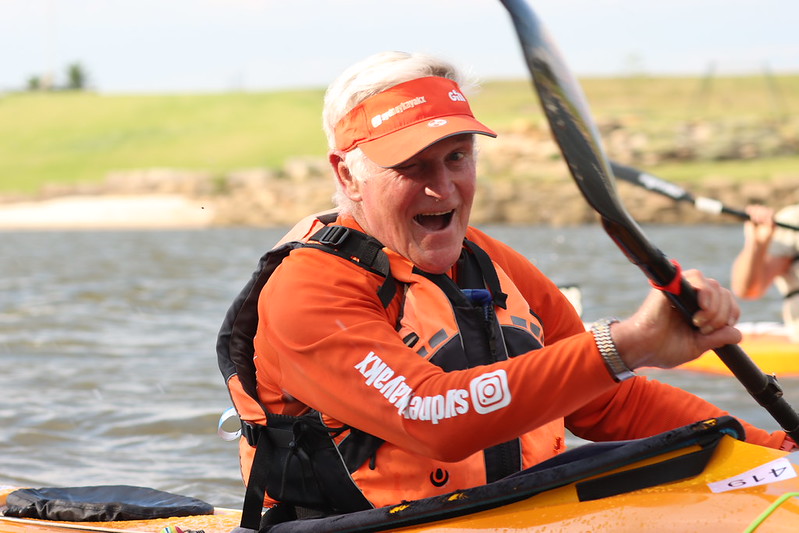
Above: Adrian at Pitt Town (photo: Ian W)
Tom Simmat 13:53:22
Below is a picture of the current wife Christine land crewing for the HCC in 1991. (When the start was on the other side of the river.)
I hired a couple of SEAWASPS and did the race with my son who was then 16. Kobi competed as part of his Queen Scout award and it was signed off the then HCC race director.
Christine has land crewed for every Hawkesbury since. We only missed a few so probably about 30. I did not finish all of them for various reasons like home made Kayaks sinking. This is a bigger problem for landcrew because she had to go back and find me, often on the opposite side of the river.
I think landcrewing for 30 classics is quite an achievement, - she says landcrewing has aged her.
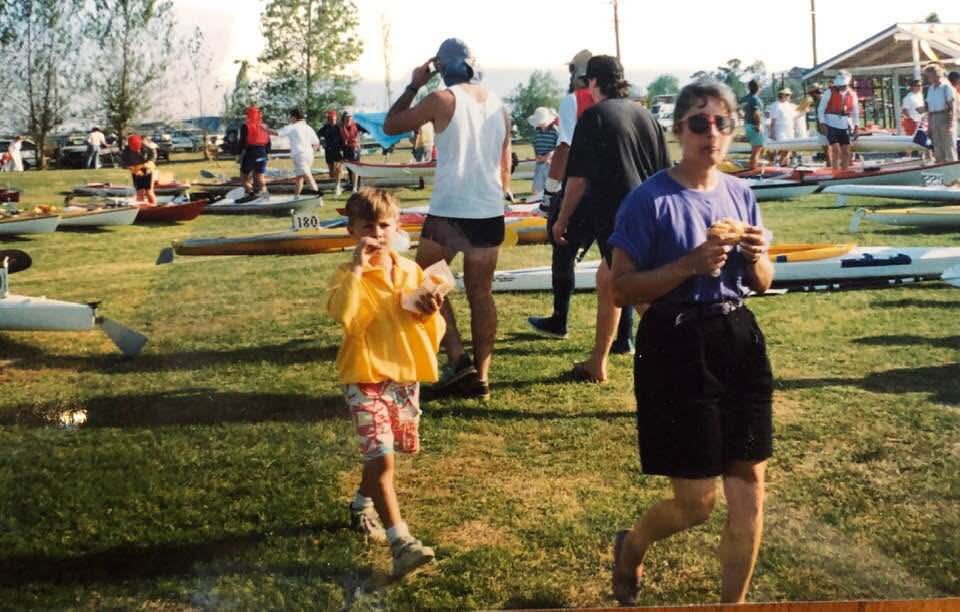
|Above: Christine landcrew at Windsor 1991 (photo: Tom S)
Lyn Battle's First HCC - From Sweers Island to the Hawkesbury…
- CLICK for a (longer) PDF version of Lyn's report
For a couple of years now Richard Barnes has been saying to me “It’s time Lyn had a Big Adventure…” I’d followed his epic Blue Moon Tasman crossings online, telling him all about my “Little Adventures” and we met in person after he came back from New Zealand. Living on a remote island in the Gulf of Carpentaria, his suggestion to “Do the Hawkesbury” seemed way beyond reach, but then we retired to Cairns and he set me a deadline: “Do it with me in a Double in 2025!” How could I refuse!
I’d sold my Mirage 530 thinking I wouldn’t be paddling in the “crocodile infested waterways” around Cairns, buying a little red Dancer so at least I could keep up my rolling in the pool. Then I discovered the Wake Park around the corner, and the owners kindly gave me permission to paddle there early mornings. But the Dancer just didn’t want to track straight, and I ended up with a torn rotator cuff tendon… I taped a SUP fin to the bottom of the Dancer – yay! Now it tracks like a surfski…well, not quite but no more jerking it round into line! A neighbour introduced me to the Cairns Beaches Outrigger Club – this got me out on the sea for some energetic paddling in an OC6. While I loved being back on the ocean, my shoulder wasn’t liking the higher angle paddling stroke. Through Townsville Kayak Club I met a local bunch of recreational kayakers who paddled on the sea when conditions were perfect, or up on the lakes of the Atherton Tableland. I’d found my tribe! Group leader Rhonda let me join them on some good distance offshore paddles, and we joined the Tinaroo Canoe Club to improve our skills. I bought an affordable plastic sea kayak, now I had 2 kayaks in the garage, feeling like a paddler again! My kayaking world was expanding from ‘just rolling in the pool’ and getting closer to that famed river down south…
Richard kept checking in on my progress, and we managed to meet up in Sydney in July for a couple of night paddles on the Lane Cove River. It was freezing! But thanks to Ian Wrenford and my friend Jacqui, I discovered the magic of Thermals! I loved paddling the river in moonlight and the whole dream suddenly became real and do-able. I flew home to Cairns and started shopping! Beanies, pogies, Salty Cheeks leggings with seating pad inserts: every parcel had the neighbours curious and excited as they too became drawn in to this Big Adventure…
Some of the Tinaroo Club had taken part in the HCC plus other long-distance events and offered plenty of tips and helpful suggestions, as well as a Double canoe so Rhonda & I could practice all the things I might encounter on the Hawkesbury (though we didn’t factor in all those jumping fish haha!) I booked my flight and packed my bag…
It was a magical night that I will never forget: The festival atmosphere on the Windsor lawns, the smiling volunteers along the way with hot soup, hot chocolate, helping hands when legs wouldn’t push up out of cockpits; the comfort of seeing those checkpoint boats mid river, lit up like Christmas trees, calling out good wishes as we plodded past; the shooting stars and unexpected fireworks to guide the way, the near-full moon shining down on slick water; the kayaks that paused alongside for a chat, the bonfire at Pit Stop; locals cheering us along, while we cheered the serious racers as they sped past; the excitement of the finish – it almost finished too soon for me, if Richard had said we had another bend to go round, I would have done it gladly! We finished in 14 ½ hours and thanks to keeping a steady pace, we finished with no blisters, no backache, no regrets. It was everything Richard promised and more and I can’t wait to do it all again. I’m trying to talk Rhonda and Jacqui into doing it too!!!
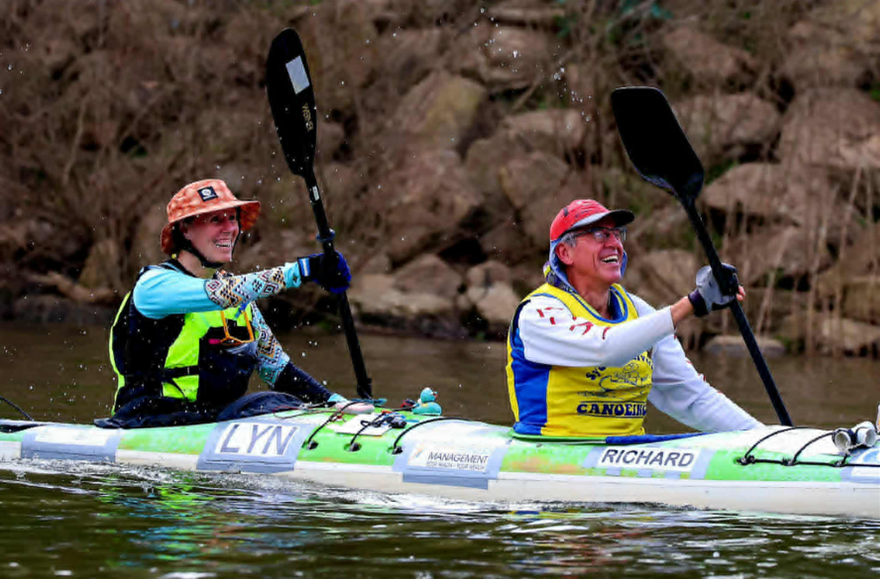
Above: Lyn & Richard at Windsor (photo: Tom H)
Wisemans - Mudlarking About - from Selina F
The LCRK volunteer squad knew they had an important job to do. While we weren’t the main characters, hopefully enhancing the quality of life of our paddlers enabled one or two inspiring stories!
The main centre of operations was set up at Wiseman’s, where Steve press-ganged the SES to help get the marquee off the car, and the volunteers engaged latent structural engineering prowess to assemble the marquee and lights. Elke swung into action setting up the catering station, including some of her very own tasty creations. Andrew saved the day when he arrived with mosquito repellent which left us with nothing left to do but enjoy time with the land crew in the time honoured tradition of hurry-up-and-wait.
There was great hollering and excitement when our LCRK paddlers started flying past (James, Dimi, Naomi and Alex). The mudlarks took up stations with Steve, Merry, Esther and Selina luring various land crew into the ankle deep water where we got to welcoming in our first few LCRK-ers: Don, Mark and Muz. Paddlers continued arriving in various states – we had cramps, injuries and zombies, with tales of swims, soreness and grit. Special mention to Merry and Esther who at one point found themselves clearing a boat that had doubled as a cereal bowl! Paddlers were lucky we had Alanna on sentry duty (nimbly perched on the log) and the mudlarks were lucky when JD got the dancefloor started with his portable tunes. For those whose night ended at Wisemans there were celebrations (planned finishers like Duncan and Mark) and commiserations (unplanned finishers). For those who kept going, it was amazing to watch people dig deep to hop back into their boats and paddle off into the night (Adrian was a particularly worthy mention after his various bumps and swims). As the night wore on the tunes got louder, the log-based dance moves more precarious and the tide higher. By the time our final LCRK-ers came through, the most intrepid of us were waist deep waving them into the beach and sending them off with probably more oomph than was ideal for stability.
Finally, Justin declared that the last red dot had passed, and we braved the pinch points (several), the bugs (innumerable) and the leftover snacks (few) to pack down the marquee, lights and trestle tables. Time to head home and watch the rest of the dots from the comfort of the couch!
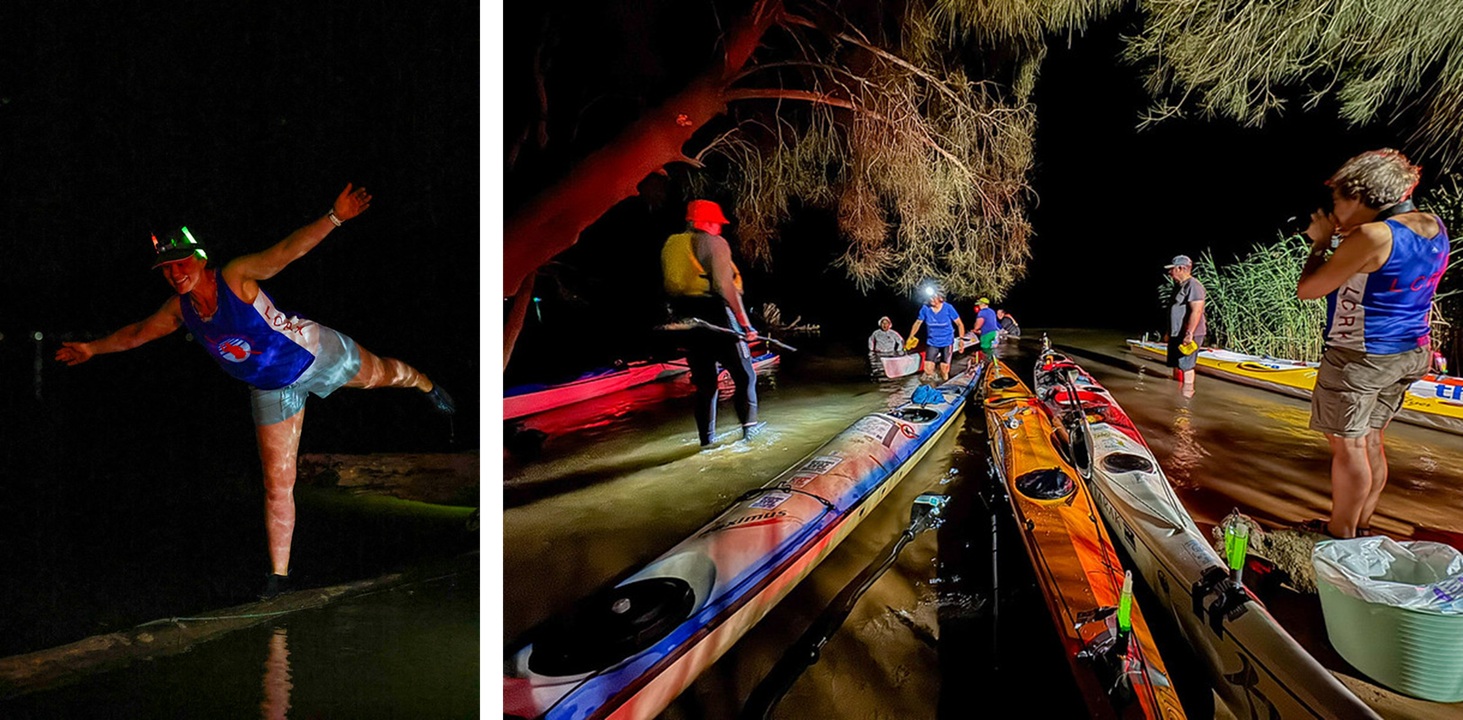
Above: Wisemans -Aura Farming, and Boat Farm (photos: Tom H)